
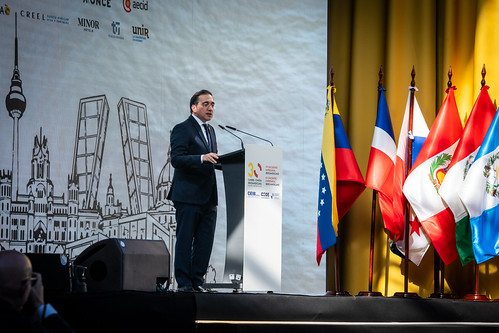
Business leaders and government representatives agreed on the need to strengthen strategic alliances to drive productive transformation and economic growth across Ibero-America.
Collaboration between governments and companies was one of the central themes of the 16th Ibero-American Business Summit, held on November 3 and 4, 2026, in Madrid, Spain.
The forum brought together representatives of the public and private sectors to analyze mechanisms to boost investment, improve competitiveness and develop strategic projects for the region’s economies.
Public-private cooperation took a prominent place on the agenda of the meeting, organized by the Ibero-American General Secretariat (SEGIB), the Council of Ibero-American Business Leaders (CEIB) and the Spanish Confederation of Business Organizations (CEOE), within the framework of the 30th Ibero-American Summit.
A shared agenda for governments and business
The second day featured the session “State and Business: A Shared Agenda for Public-Private Dialogue,” dedicated to exploring opportunities for collaboration between government institutions and business organizations.
The discussion brought together representatives from several countries to address the need to build favorable conditions for investment and productive development.
Key topics included institutional stability, legal certainty and the strengthening of the region’s economic capabilities.
Collaboration between both sectors was presented as a tool to respond to challenges that require investment, innovation and institutional coordination.
Dialogue with heads of state and government
One of the highlights of the summit was a conversation led by Ibero-American Secretary General Andrés Allamand, with the participation of leaders from Spain, Costa Rica, the Dominican Republic, Bolivia and Portugal.
The dialogue addressed entrepreneurship, investment, climate change, artificial intelligence and the need to strengthen institutions.
Spanish Prime Minister Pedro Sánchez underscored the importance of collaboration between the public and private sectors in responding to challenges such as technological transformation and the climate emergency.
Portuguese Prime Minister Luís Montenegro, for his part, highlighted the role of small and medium-sized enterprises in the economy and the need to take advantage of the ties between countries.
Ten commitments for the region’s economic future
As a result of the summit, Antonio Garamendi, president of CEOE and CEIB, presented the Business Commitment for the Future of Ibero-America.
The document sets out ten commitments related to economic growth, productive investment, quality employment, digital transformation and the strengthening of small and medium-sized enterprises.
It also includes proposals to foster a more inclusive economy, promote business formalization and consolidate public-private collaboration.
One of its proposals is to establish monitoring mechanisms based on indicators to assess progress and strengthen accountability.
The document was presented to the heads of state and government as the private sector’s contribution to the regional agenda.
Mexican business participation
Mexico is among the countries with opportunities to strengthen business cooperation and expand its trade ties with other Ibero-American economies.
The Mexican Business Council for Foreign Trade, Investment and Technology (COMCE) promoted the participation of the Mexican business sector in the summit as part of its efforts to advance international trade relations.
Regional collaboration can help identify investment opportunities, develop strategic alliances and strengthen the integration of Mexican companies into international markets.
King Felipe VI closes the summit
The 16th Ibero-American Business Summit concluded with the participation of King Felipe VI, who stressed the importance of governments and companies assuming complementary responsibilities to drive economic development.
The closing ceremony also included the presentation of the Ibero-American Quality Awards and the handover of the CEIB presidency from Antonio Garamendi to Anabel Gallardo, president of the Honduran Council of Private Enterprise.
With the presentation of the business commitments, the summit closed two days of dialogue aimed at strengthening economic cooperation and competitiveness across Ibero-America.
